Thursday, February 9, 2012

1910-1950

This time period is easier to get artists from, seeing as many of the works in the smithsonian museum of modern art back home in D.C. are from this period. It makes me remember a time when I went with my family to the museums one summer day and an exhibit with the artist that my entire family loved. 

Edward Hopper (Born July 22, 1882 and died May 15th of '67) is by far one of my favorite paint on canvas artists. To me, his works scream volumes in their silence, make one put themselves into the subject's point of view and wonder what they are thinking. I have written countless stories looking at Hopper's paintings and I'm sure others were inspired by the work. Here are four of my favorites:

"Automat" (1927)

"Hotel Room" (1931)

"Summer Evening" (1947)


"Nighthawks" (1942)

In an Edward Hopper painting, it seems as if no one speaks, like he took a picture at the lull of conversation and painted over it. The people alone look contemplative and the rooms they're in always speak as loud as the people. My favorite is Nighthawks, when I saw it when I was younger I was oddly fascinated by it and even bought a print of it (which is currently still up in my room back in Virginia). 

It also helps to know that the 20s to late 50s is my favorite time period when it comes to entertainment and fashion (I'm also very fascinated about WWII era history). So Hopper painting the essence of this time period makes me love his work even more.

Thursday, February 2, 2012

1860-1910

When asked to find works that reflect our tastes form this time period, I must say I had a hard time imagining finding anything that I would find interesting. As much as the art of impressionism is fascinating and boundless I found myself not too into the idea of talking about the subject.

But then I realized during the later years of this period came one of my favorite artists to this day ( I recently became enamored with him when the internet exploded with adaptations of his work).

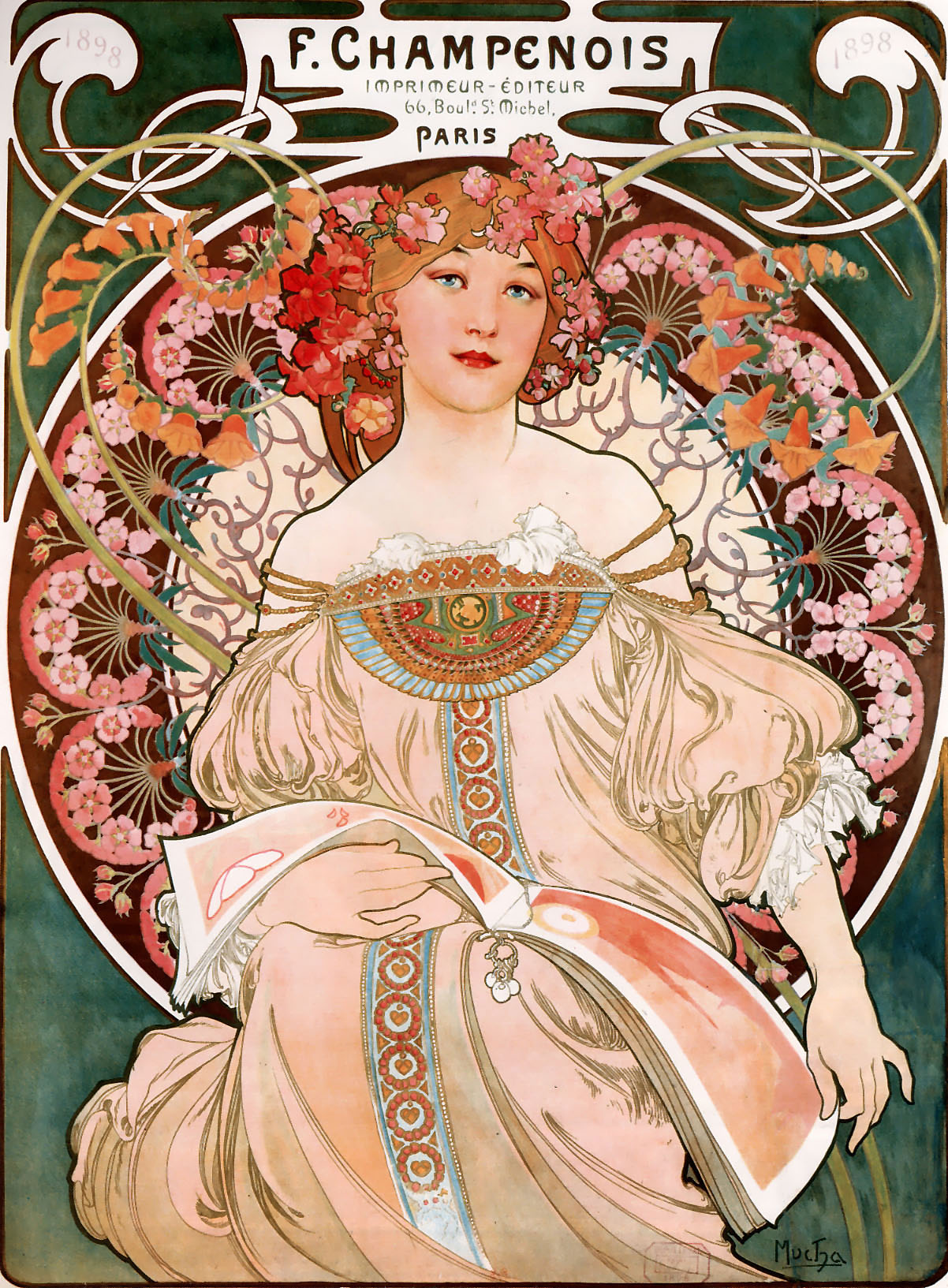
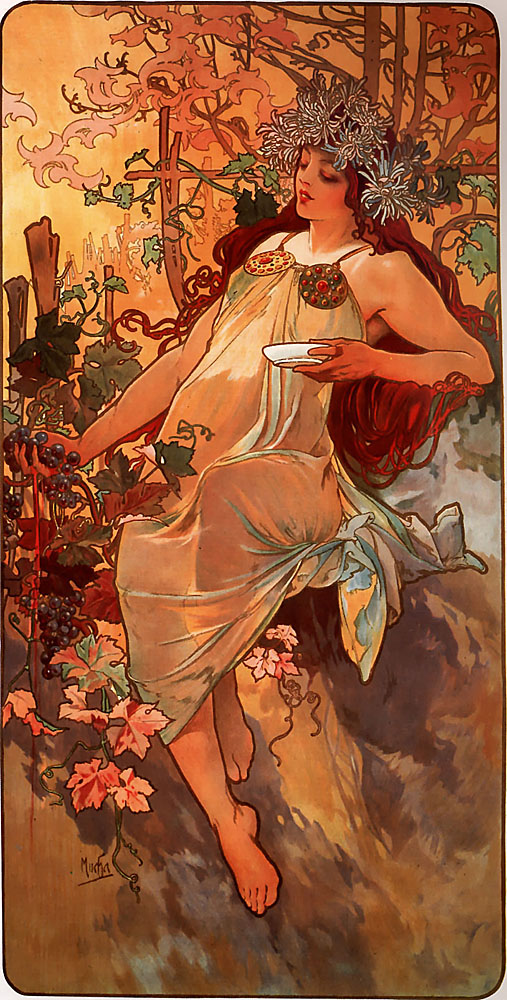
I talk about the late great Alphonse Mucha, who in my opinion, is the father of Art Nouveau.

For him, I look to 3 pieces that I instantly fell in love with:

Autumn (1896)
F. Champenois Imprimeur-Editeur (1897)
Medea (1898)

All three are gorgeous entities that are quite enchanting to me. With a small amount of space, Mucha is able to make the most of the space he is given. The vibrant use of colors and even type he uses makes everything interesting, and all the women seem to have a mystery about them and even a great power.

As much as I love Mucha, he will not help me when it comes to doing the next few blogs, so I had to look to another artist I could easily find. And with that I found Gustav Klimt. I however give more favor to the golden phase of his work which is at the very end of the time period. 

Judith and the Head of Holofernes (1901)

The Kiss (1907-08)

The interesting thing about these pieces is the fact that he uses gold foil and other gold substances (dust) to create these pieces. I know that one piece form his gold period is on display at the MoMA, so it will be interesting to see how the gold and paint intermingle to make a masterpiece.

As a side not, I always think of this song when I see his work (Mainly because the opening of the anime mirrors the works of Klimt).


Thursday, January 26, 2012

What is Art?

Good question, many answers. For centuries the question has been pondered and therefore has evolved with time. However, there are some definitions that can hold true through time.


For this I look to Friedrich Nietzsche, who so happens to be one of my favorite philosophers (an odd thing to say, but I fell in love with him when I read the quote "He who fights with monsters should be careful lest he thereby become a monster. And if thou gaze long into an abyss, the abyss will also gaze into thee").


He has two quotes on the subject of art that I find appealing for answering the question:


"We have art so that we may not perish by the truth."


So in a way, he says that art is our protector from truth. But what's so abhorrent about the truth that we need the armor of creativity? In this I think he says that art is a form of escapism that allows us to escape from something harsh. We need these moments, in my opinion, to stay sane when the world is constantly trying to bring you down. 

"Art is not merely an imitation of the reality of nature, but in truth a metaphysical supplement to the reality of nature, placed alongside thereof for its conquest."

With this, we find an elaboration to the first quote. Art complements nature (or life) so that we may conquer it. So now, not only is art the armor, but the weapon so that we may protect ourselves from the harsh reality of what we may be dealt. Art is the crusade, the knight of escapism that grants us relief from the mundane and cruel hands of nature.

Wednesday, January 25, 2012

TRANSITION!!

This will now be a blog about art.

Scary huh?
(On a side note, my favorite artist is Ansel Adams, but I have several budding artists on the internet that I follow)